Buggy Eyes and a Big Butt, part eight: Movies 104-120

Pencilstorm contributor Rob Braithwaite is watching 366 movies this year, so you don't have to, here is part eight of his continuing 2016 rundown......

Q&A Intro, 1-17, 18-36, 37-51, 52-66, 67-74, 75-87, 88-103, 104-120, 121-131, 132-152, 153-173, 174-187, 188-221, 222-255, 256-287, 288-314, 315-341, 342-366, Index

Ratings key:
★ ★ ★ ★ ★ = I can’t see giving anything that I’ve seen once five stars
★ ★ ★ ★ = get to the theater / move it up in your queue
★ ★ ★ = “three stars is a recommendation” - The Empire [magazine] Podcast
★ ★ = if the remote is too far away, you could do worse
★ = if the remote is too far away, get someone to move it closer then throw it at the TV

104
Gilda (1946) ★ ★
stars: Rita Hayworth, Glenn Ford, George Macready
director: Charles Vidor

A crooked gambler, fresh off the boat to Argentina, goes to work for a casino owner who happens to marry his ex. That’s a big coincidence considering the exes weren’t from Argentina. There’s still a hateful passion between them. Sabotage, self and outward, run rampant. No one is likable. And there are two musical numbers.

Fresh off the Boat is a funny show.

watch The Shawshank Redemption instead

105
The Ascent (1977) ★ ★ ★.5
stars: Boris Plotnikov, Vladimir Gostyukhin, Anatoliy Solonitsyn
director: Larisa Shepitko

Two Soviet partisans search for food in German-occupied Russia during World War Two. What begins as a mission for sustenance for their group becomes a exploration of what it means to survive in an occupied land. Leaning on the idea that righteousness is death and compromise fuels guilt, it’s a tough call.

double feature pairing: Red Dawn (1984)

106
Notorious (1946) ★ ★
stars: Cary Grant, Ingrid Bergman, Claude Rains
director: Alfred Hitchcock

The U.S. government whores out the daughter of a German spy to infiltrate a Nazi collective in Rio de Janeiro. She falls in love with her U.S. handler. He loves her. They would run away together if they would only tell each other how they feel. But they don’t, so she goes on with the mission and he acts like a hurt puppy because she’s “going all the way” (read: sex).

Jesus. This is a classic? I’ve always been too critical of Brian De Palma because of his sometimes on-the-nose camera work. I’m aware of his Hitchcock influence but thought he lead the audience much more. My apologies. Hitchcock is just as bad.

If you haven’t figured it out, THE POISON IS IN THE TEA!

If you haven’t figured it out, THE POISON IS IN THE TEA!

watch The Boys from Brazil instead

107
Breathless (1960) ★ ★ ★
stars: Jean-Paul Belmondo, Jean Seberg
director: Jean-Luc Godard

A man kills a policeman after stealing a car. Risking capture, he returns to a girl he’s infatuated with in hopes that she will run off with him despite not knowing each other that well.

I liked this much more thinking about it afterwards than when I was watching it. His checking the latest version of the newspaper for details of his crime was subtly tense. And the long bedroom scene is great in retrospect.

double feature pairing: Miami Blues

108
Cleo from 5 to 7 (1962) ★ ★ ★ ★
stars: Corinne Marchand, Antoine Bourseiller, Dominique Davray
director: Agnès Varda

Cleo is a singer with a few hits on the radio. Her pampered lifestyle is shaken during an afternoon as she awaits test results from her doctor. Her world and mindset free from a restrictive state as the afternoon rolls on. The set design and camera work in her apartment are brilliant.

double feature pairing: Nick of Time

109
The Browning Version (1951) ★ ★ ★
stars: Michael Redgrave, Jean Kent, Nigel Patrick
director: Anthony Asquith

A stick-in-the-mud Latin teacher of a prep school is leaving for health reasons. The kids are happy. His adulterous wife couldn't care less. He lives with regret of not being better or fully understood. The movie is fine. He makes some nice inroads with a student and his wife’s lover. There’s a reason Latin isn't taught in high school anymore: Bor-ring.

double feature pairing: Dead Poets Society

110
Captain America: Civil War (2016) ★ ★ ★ ★
stars: Chris Evans, Robert Downey Jr., Sebastian Stan
directors: Anthony Russo, Joe Russo

Finally! Someone’s punching something! Whoa! That totally blew up! HAHAHA!!!

This is the best Marvel movie*. The action is great. It’s really funny. And there is emotional weight. I never would have guessed the best Marvel series would have been Captain America’s.

“That sounds great,” you say. “I’ve never seen a Marvel movie.”

Well, don’t start here. We’ve reached the point where you can’t jump in and still get the full impact. You’ll be able to follow it, sure — events and personal ties are referenced — but showing is always better than telling.

Don’t worry. You don’t have to watch the twelve others. Six will do…

triple double feature marathon (+1): Captain America: The First Avenger, The Avengers, Iron Man 3, Captain America: Winter Soldier, Ant-Man, Avengers: Age of Ultron

*confirmation in 5-10 years.

111
Dealin’ with Idiots (2013) ★ ★
stars: Jeff Garlin, Bob Odenkirk. J.B. Smoove
co-writer/director: Jeff Garlin

What if the camera filming The Bad News Bears were pointed the other way, filming the parents? Then I’d say to turn the camera back around.

There are funny people saying funny things. If it was a straight forward presentation of the personalities of little league parents it might have been better. However, Garlin’s character tells the parents he wants to interview them for a movie he’s researching. This forces some of the interactions in an artificial way that makes the scene look just like that, a scene.

double feature pairing: The Sandlot

112
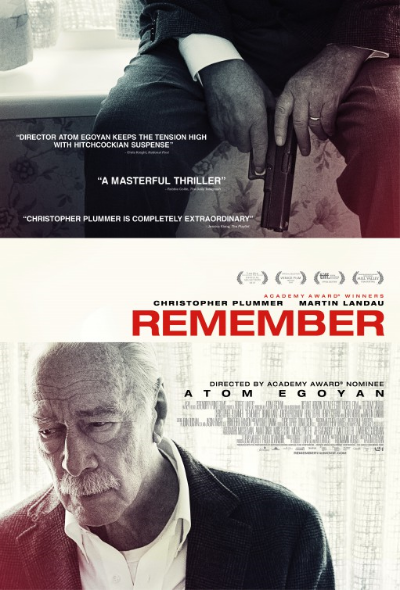
Remember (2015) ★ ★ ★ ★
stars: Christopher Plumber, Martin Landau, Dean Norris
director: Atom Egoyan

An Auschwitz survivor with dementia goes on the hunt for the Nazi-in-hiding who killed his family.

Don’t watch the trailer. It gives too much away.

Don’t believe the poster being used for the video release. This isn’t a Taken movie.

Christopher Plumber is amazing. And there are turns I wasn’t expecting.

double feature pairing: Memento

113
The Family Fang (2015) ★ ★ ★ ★
stars: Nicole Kidman, Jason Bateman, Christopher Walken
director: Jason Bateman

The Parents Fang used The Siblings Fang as instruments in their real-world art projects. Now grown, the siblings are less-than-stable when their parents disappear. One suspects this is another art piece, while the other is prepared for the worst.

I hope Jason Bateman continues directing. Bad Words is good, and this showed some style. It was nice to see Nicole Kidman in something again. Christopher Walken wasn’t the caricature I’ve come to expect.

double feature pairing: The Royal Tenenbaums

114
The League of Gentlemen (1960) ★ ★ ★
stars: Jack Hawkins, Nigel Patrick, Richard Attenborough
director: Basil Dearden

A retired military officer recruits fellow military men for a bank heist, the idea for which he got from the plot of a novel. No joke. These men, each their own brand of shady, robbed a bank like it happened in a book. Where was the Outraged Parents Society in 1960? Books are a path to criminal activity!

The movie is fine. Good bank robbing technique. What was the name of the book again?

double feature pairing: Heat

115
In a Lonely Place (1950) ★ ★ ★.5
stars: Humphrey Bogart, Gloria Grahame, Frank Lovejoy
director: Nicholas Ray

A screenwriter with a short fuse is accused of murder. He enters into a relationship with his new neighbor who provided his alibi. She begins to wonder if his jealousy, paranoia and fits of rage aren’t the makings of a murderer after all.

Based on one throw-away line and a 21st century eye, this has an undercurrent of a man suffering from PTSD. I don’t think that is intentional, but it certainly helps in finding some sympathy for an unlikable lead, expertly performed by Bogart.

Includes a descriptor that you don't hear much these days: he made all his money before the income tax.

double feature pairing: Seven Psychopaths

116
Murder on the Orient Express (1974) ★ ★
stars: Albert Finney, Lauren Bacall, Martin Balsam
director: Sidney Lumet

Murder was the train that they gave me.

Maybe this movie wouldn’t have been such a grind if there weren’t as many characters. After an epilogue, we meet fifteen to sixteen people. There’s a murder. Then there are thirteen interviews. There’s a resolution. Then we watch eleven people individually toast two others. Guh, get on with it!

watch Clue instead

117
The Trust (2016) ★ ★ ★.5
stars: Nicolas Cage, Elijah Wood
directors: Alex Brewer, Benjamin Brewer

Two cops rob a mysterious vault.

Nicolas Cage has muddied his filmography a great deal, so saying this is his best movie in years isn’t saying much. But, it is his best movie since Joe and his best comedic and vibrant performance since Kick-Ass.

The motivation of Cage’s character is heavily inferred. The movie seems to rely on the viewer knowing this genre to pick up on certain things. It was off-putting at first but I think I liked it this way. As the story progresses, we learned who this person really is, just as his partner does.

If nothing else, this gave me one of my favorite montages.

double feature pairing: Before the Devil Knows You're Dead

118
Hell in the Pacific (1968) ★ ★ ★ ★
stars: Lee Marvin, Toshirô Mifune
director: John Boorman

American Soldier washes up on an island shore that Japanese Soldier solely inhabits. How will they react to one another as World War Two rages on with out them?

The lack of subtitles allows us to share in the men’s frustration in dealing with each other. The cinematography and framing are artful. The performances are impressive. The ending is abrupt and, if IMDb is to believed, a complete fabrication of the studio without John Boorman’s approval. The director’s superior ending is on the DVD as an extra and is in keeping with the rest of the movie.

double feature pairing: Enemy Mine

119
Poltergeist (2015) ★
stars: Sam Rockwell, Rosemarie DeWitt, Jared Harris
director: Gil Kenan

What was the point?

watch Poltergeist (1982) instead

120
Night and the City (1950) ★ ★ ★ ★
stars: Richard Widmark, Gene Tierney, Googie Withers
director: Jules Dassin

A hustler who's always on the lookout for the next big score finds himself in a position to become a successful wrestling promoter if he can orchestrate some powerful people the right way.

An impressive noir story that doesn’t involve a single gun. The way the plan falls apart is very unique.

Gene Tierney is second billed but has very little to do as the put-upon girlfriend/club singer. Her chummy neighbor is introduced for the sole purpose to make sure she has a man to pick her up at the end. A sign of the times, certainly genre. At least now, she would have… eh, maybe it wouldn’t be too different now. Someone of lower stature would have had that role instead.

double feature pairing: Barton Fink

Counters:
120/366 movies (16 movies off pace)
17/52 movies directed by women

THE TOP THREE

cap.jpg

Trouble Boys: The True Story of the Replacements

In his new band biography of The Replacements, Bob Mehr offers the ballad of a troubling band and delivers with his welts-and-all approach to storytelling

Band photo by Deborah Feingold


By James A. Baumann

It is difficult to find someone who merely “likes” The Replacements. Rather, the band’s admirers generally are devout fanatics for whom each shredded guitar solo is a sacrament and every lyrical turn-of-phrase is gospel. For those individuals, the word that a definitive written history of the band was forthcoming generated a great deal of record store and bar stool speculation. How much would the reclusive band members be involved in the project? What truths would be uncovered? What new stories would be added to their legend? 

Any reservations the fans may have had were unfounded as, with Trouble Boys: The True Story of The Replacements, Bob Mehr presents about as complete a picture of a rock and roll band as you’re going to find. Mehr, the music critic for the Memphis Commercial Appeal and a correspondent for MOJO magazine, fills almost 450 pages as he tackles his subject with the vigor and depth usually reserved for the Founding Fathers.

He doesn’t pull any punches either. The book opens on the scene at the funeral of founding guitarist Bob Stinson. Within the first 20 pages, the abandonment and abuse he experienced as a child has been well documented. Mehr goes on to tell similar origin stories for Stinson’s bassist kid brother Tommy, drummer Chris Mars, and singer/songwriter Paul Westerberg. Collectively, Westerberg described them all as “miscreants who had no other choice, had no other road out. We were one of the few, the chosen, you know? It was either this or… jail, death, or janitor.” Such is the sentiment of much of the band’s story and while it was one they were happy to project, Mehr illustrates in amazing detail the many ways in which it manifested itself.

The Replacements were notorious as the band that couldn’t catch a break and, even if they did, would find a way to let it slip through their fingers. Their prickly dispositions and refusal to play the music business game – abstaining from appearing in videos, drunken industry showcases, feuding with executives and producers, etc. – helped make the band infamous rather than famous. Mehr captures those stories and augments them with examination of the reasoning and conditions behind these antics as well as the fallout afterward.

The band’s reputation as the loveable losers takes a hit as Mehr recounts stories from a number of producers, managers, publicists, label heads, bus drivers, radio programmers, and others who found themselves in the band’s crosshairs. These were all people who ostensibly were working with the band’s best interests at heart. However, they could find themselves caught up in the band’s antics, showing that self-destructive behavior isn’t always limited to the “self” in question.

While The Replacements’ appeal came, in large part, from their us-against-the-world credo, Mehr also shows that they saved some of their harshest blows for each other. He repeatedly points out how Bob Stinson couldn’t shake the feeling that Westerberg had stolen his band from him. Then, later, he must have felt that he also lost the role of Tommy’s big brother. Once Stinson and his troubling drug use was driven out of the band, Chris Mars and his introverted personality became a target. Even Slim Dunlap and Steve Foley -- the replacement Replacements -- were not immune to hazing rituals of sorts.

This is not to say that the story doesn’t include plenty of moments of love, comradery, and brotherhood between the players. They describe it themselves as a gang mentality that they carried with them as they tour Twin Cities watering holes, garner critical acclaim, and steal their own Twin Tone tapes. In addition, when they were practicing in the Stinson family basement, the likely couldn’t imagine that they would one day see the world touring and hanging with contemporaries such as REM and the Young Fresh Fellows as well as getting to rub elbows with heroes like Tom Waits, Bob Dylan, and Keith Richards.

In the end, the book wraps up with the band members, previously scattered to the wind, rallying around the side of Dunlap after he suffers a stroke, as well as Stinson and Westerberg’s all-too-few Replacements reunion shows. Even the sad scene of Bob Stinson’s funeral closes with Westerberg tearfully clutching Stinson’s ex-wife saying “We were just kids. We didn’t know shit. We were… just kids.”

For all the hard knocks and divisiveness, though, Mehr doesn’t forget that if the songs and performances weren’t so strong, nothing else would have mattered. Readers get to hear the stories behind some of the most famous songs and, in particular, the work that went into getting them on tape. As the self-taught band grows and is pushed into more “professional” recordings, we see them both bristle and mature.

Of particular note are the chapters around the recording of Pleased to Meet Me. Coming in the wake of Tim – an album that featured some incredible songs yet some questionable production choices -- this would be the first record without Bob Stinson. It was recorded under the helm of producer Jim Dickinson in Ardent Studios, replete with all the history that comes with it. Tommy Stinson was beginning to flex his musical muscles. And, of course, these sessions would produce the renowned “vomit on the ceiling” story.

While all Replacements fans have their own favorites, in many ways this was to be the place where all the pieces clicked together. They had the songs – classics like “Alex Chilton” and “Can’t Hardly Wait.” It had recording sessions that taxed and tested the players to give their best performances. It had studio production gloss. It had label support. The band even agreed to appear in a video. It had everything.

Except a hit.

Bob Mehr took time from his schedule to share his thoughts on the work and passion that went into this project and why The Replacments were deserving of this level of analysis.

Trouble Boys cover

Baumann: First is the big question: How? Considering how notorious the band members have been about not talking about the past, not participating much in reissues, general surliness, etc., how did you get them and their many layers of acquaintances to open up for the interviews and research needed to make this book happen?

MEHR: Frankly, I wasn’t interested in writing anything without the band’s direct involvement. That had already been done, and the results were never really satisfying to me. Fundamentally, the question I wanted to answer in the Replacements story was “why?” Why did they form the band? Why did they make the music they did? Why did their career evolve/devolve as it did? The only way to really get those answers was to have the band members and those closest to them involved in the process, and to persuade them all to reflect honestly on their lives.

Over a period of years, working as a music critic, I’d developed casual relationships with Westerberg and Stinson, but also crucially with key people within their circle, particularly the Replacements’ longtime manager Peter Jesperson and Westerberg’s current manager Darren Hill. Both men were ardent champions of this project from the start, and without their support early on, and at critical points throughout the process, there’s absolutely no way the book could have been written.

In the spring of 2007, I decided it was time to pitch the project formally to them. Westerberg liked my written proposal, but initially suggested we collaborate on his memoir instead. While I was flattered by the offer, I knew that the story I wanted to tell was bigger than just Paul. Not long after, I had dinner with Tommy in Los Angeles, and he was the first to formally agree to participate in the book – with the caveat that he would only do it Paul was on board.

A few months later I found myself back in Minneapolis doing a story on the band for SPIN. Had a long face-to-face with Westerberg there, and we discussed a Replacements biography in-depth: what the process would entail and how, if the book was to mean anything, it would have to get into some darker, and sometimes unpleasant territory. I think Westerberg understood, even better than I did at the time, how difficult the process was going to be for me, given the band’s somewhat tortured personal and professional history.      

After our meeting, Westerberg agreed to participate, as a result so did Tommy, and I was able to move ahead with the project – with the understanding that although they would be involved, it would not be an “authorized” bio and the band would have no editorial control over the finished product. In short: they would give me everything I needed, but it was my book to write.

Ultimately with Paul and Tommy and Peter Jesperson on board nearly everyone else was happy to participate (the notable exception being Chris Mars, who’d developed a standing policy of not discussing the Replacements; though I was able to give him voice in the book, thanks to some previous interviews that myself and several other journalist friends had conducted).

As to why Paul and Tommy agreed? My guess is that enough time had passed from the break-up of the band in 1991, and the death of Bob Stinson in 1995, that they were willing and able to finally look back and grapple with the life and legacy of the Replacements. That’s something they had never done. By the time I came into the picture, I think they needed to do that for themselves as much as anything. The book became the vehicle for that reckoning, I suppose.  

BAUMANN: Second big question: Why? What is it about The Replacements that elicited the type of determination you would need for a project this large?

First and foremost, I loved the band – the music, the romance and the cult and culture that developed around them. But more than that I knew there was a compelling story there – not just about one rock and roll band, but a whole era of the music business. I also felt that a band as intense and profound as the Replacements had something more propelling them than the usual desire for fame and fortune Instinctively, I felt like whatever was pushing them (and also dragging them down) was rooted in their childhoods and formative years.

BAUMANN: Everyone I've spoken with who read the book has been taken by the extensive depth you were able to go into (such as family histories, etc.) and chose to go into. Was that a conscientious goal from the beginning?

MEHR: As I got deeper into my research it became clear how central those personal histories were to the story of this particular band. Especially as it related to Bob and Tommy Stinson, but also to Westerberg, Mars, Jesperson, and so many of the people who would come to work with and play a major role in the band’s career. I don’t think there were any accidents or coincidences when it came to those who were part of the Replacements story. The people who were closest to them were there for a reason – because they understood them, shared the same background and demons, or found something transcendent in their music that expressed some wounded part of themselves. At the end of the day, the book is the story of families – damaged families of origin, and new families we create as a response to that.

BAUMANN: In a similar vein, with a band as renowned as The Replacements, I think there exists the danger of falling into the old saying of, "when the legend becomes fact, print the legend." That could certainly have been the case for stories like the infamous Portland show or the run-in with Bob Dylan in the recording studio. Was this something you wrestled with while working on the book? Was the extensive research an antidote to that? 

MEHR: Yes, the Replacements are probably the ultimate example of that phenomenon. So much of their story – their behavior and antics, on stage and off – graduated to the realm of myth and legend, they’ve been handed down almost as folk stories. As it turned out, some of the most outrageous things, the tales that seemed the tallest, happened to be true. But generally from a research perspective, I did try and throw out what I knew, or thought I knew, forget everything I had read or heard, and start from scratch.

BAUMANN: Continuing down that line, did you have to resist the urge to play armchair psychiatrist as you were writing the book and recounting all these cases of extreme behavior up and down the spectrum? I think, in the end, the book does an excellent job of "show, don't tell" in that regard. But I am assuming that your opinions and thoughts about the band -- outside of their music -- had to have roller coastered during the research and writing.

MEHR: It’s hard not to speculate or draw conclusions as a biographer, especially when you live with a project as long as I lived with this one. I’m sure in the earlier drafts of the book there was more armchair analysis on my part, more speculation as to motives and meaning. But in the rewriting and editing, I tried to strip that away and leave behind nothing but the story. Of course, in constructing the narrative – what you choose to include and omit – you’re making judgement calls and influencing the reader’s understanding. But as much as possible, I tried to make it so that everyone would feel like they had the information needed to draw their own conclusions about the band. I think I succeeded in as much as people’s reactions to the book have been like a Rorschach Test. Everyone sees something different in the ink blotter. And what they see probably says more about them than it does the Replacements.

BAUMANN: One of the big takeaways from the book for me was that The Replacements long were considered and portrayed as the band that couldn't catch a break and, even if they did, would find some way to sabotage it. However, your book shows that when they shot themselves in their own foot, there were a lot of other people that suffered collateral damage either personally or professionally. Was that a purposeful theme that you developed and, if so, when did it begin to emerge in the process?

MEHR: Yes, though, I’m not of the opinion that their self-sabotage was the sole reason for their relative commercial failure at the time. In some ways I think the destructive, and self-destructive, things they did have fed their legend for the last 30 years, and are a big reason why the Replacements are more popular now than they ever were, even in their ‘80s heyday. That said, I did want to show that there was fallout from the choices they made, for themselves and others around them. But I never wanted to judge them on that either. At the end of the day, the things the Replacements did hurt themselves more than anyone around them.

BAUMANN: In the end, though, it's a book about a rock and roll band. What are the handful of songs -- either from the band or solo careers -- that you think best sum up The Replacements story? What are the songs that hear differently or have a different meaning now after writing the book?

MEHR: After doing this book my respect and admiration for the Replacements – for what they achieved, for how far they got – is even greater. And, of course, knowing so much more about their lives, that can’t help but inform my understanding and appreciation for the songs as well. My hope is that I convey all that effectively in Trouble Boys, so that readers will feel that same deeper connection to the music.

If I was to come up with a list of ten tracks that conveyed some larger story, I would include the following songs from the Replacements and various post-band and solo efforts:       

Great Band, Worst Song: Van Halen's "Jump"

Van Halen – the greatest rock band of the 80's.  The original line-up will go down in history as one of the amazing hard-rock bands ever. When their songs came on the radio, you automatically turned it up.

Their drummer, Alex Van Halen, merged traditional rock beats with mind-blowing drum fills that you couldn't help but pound along on your steering wheel to. He was the first to effectively use a double bass drum, demonstrated here in Hot For Teacher.

Add in a front man, David Lee Roth, with such bravado and presence, plus a twist of humor. His ego was so huge he needed three names. This guy didn’t really care at all but knew how to sing a hook, tell a story, and make you want to come back for more. Just watch this video of Panama to truly understand this guy’s talent.

Not to mention, the world’s most underrated bass player, Michael Anthony, who was an amazing vocalist in his own right and laid down heavy righteous low-end rhythm.  Just listen to the raw bass line in Ain’t Talking About Love and the backup vocals in Beautiful Girls.

But Van Halen wouldn’t have been Van Halen without the best rock guitarist in history, Eddie Van Halen: the virtuoso who owned rock guitar in the 80's. Everyone wanted to play just like him. He came up with distorted grooves, rip-roaring bluesy solos, and perfected the tapping technique which became his signature move. He’s probably one of the most influential rock guitarists. He tops lists that include Jimi Hendrix, Frank Zappa, and Jimmy Page. Heck, even Michael Jackson asked him to guest solo on Beat It (start at 3:10). Check out the solo on Ice Cream Man.

Van Halen was an awesome band.  Even their covers were kick ass.  You Really Got Me, Dancing In The Street, Pretty Woman.

You want to hear something that rocks? Listen to any Van Halen song… any song with the original line-up and you’ll crank it up and relive what it’s like to be surrounded by 80's hard rock.

Except for one.

Jump.

This song stands out like a sore thumb on their album 1984. It had so many killer Van Halen songs… Panama… Hot For Teacher… Top JimmyDrop Dead Legs.

But what do you do when you have the world’s greatest guitar player?  You do a heavy synth song like "Jump"?  I’m not knocking the tune… it’s a great song.  But it belongs on Bon Jovi’s Slippery When Wet - not 1984.

If Poison would have recorded this song, it would be by far the best Poison song.  But it’s the worst Van Halen song.  It’s too poppy. Too synthy. Lacks a powerful bass line. Lacks any strong guitar riff. Lacks any killer drums. And lacks powerful vocals.  It’s like they took all their energy and put it into Panama and Hot For Teacher and then said, “Hey… let’s do something really cheesy. Let's do Jump.”

Unfortunately, this song opened up the era of keyboard-heavy Van Hagar… with songs as Dreams, Why Can’t This Be Love, Love Walks In, and When It’s Love.  All good tunes, but each overshadows the guitar virtuoso and hard-rockin’ band Van Halen was during the late 70's and early 80's.

The good news is, it left a void to fill from guitarists like Steve Vai, Joe Satriani, Nuno Bettencourt, and others: all of whom brought their own skills and talent to create some of the best hard-rock music we've heard.


Wal Ozello, a child of the 80s, is the former singer of the Columbus hairband Armada. He's the author of the science fiction time travel books Assignment 1989Revolution 1990 and Sacrifice 2086 and a frequent customer at Colin's Coffee.

Comic Book Movies - by Ricki C.

COMIC BOOK MOVIES, AND WHY THE CREATORS OF ART ARE NEVER THE ONES WHO
MAKE ANY MONEY, or WHY STAN LEE OF MARVEL COMICS IS A MULTI-MILLIONAIRE,
WHILE YOU’VE BARELY EVER HEARD OF JACK KIRBY.
by Ricki C.

(Before there was rock & roll in the Ricki C. universe there were comic books.  I was born in 1952 and when I was four years old I taught myself to read with comic books that my brother & sister – ten & seven years older than me – left around the house.  Al & Dianne were too old to be bothered with me at that point, and my mom & dad – children of The Depression that they were – both worked two jobs to keep our little West Side family afloat, so I had a pretty solitary childhood existence.  Not a bad existence, by any stretch of the imagination, just extremely quiet.  Before The Beatles appeared on the Ed Sullivan Show when I was twelve, superheroes brought The Noise to my world.)

The latest Marvel Studios movie – Captain America: Civil War – opens today and I’m definitely going to see it this afternoon, ‘cuz I’m kind of a sucker for comic book movies: but I’m not going to feel that good about  it, since Jack Kirby’s family is not gonna see a penny from it, and Stan Lee is just gonna get richer.  

Stan Lee and Jack Kirby were once a team.  At Marvel Comics in the early 1960’s Stan Lee wrote comic book stories and Jack Kirby drew them.  In rock & roll terms they would have been John Lennon & Paul McCartney.  Or – more accurately – they would have been Mick Jagger & Keith Richards, since Marvel Comics were the Bad Boy counterparts to the ever-so-much more straight-laced DC Comics.  (Home of Superman, Batman, Wonder Woman, Flash, Green Lantern, etc.)

Lee & Kirby ushered in the Age of Marvel in comic books – The Fantastic Four, Spiderman, The Hulk, The X-Men, Thor, Iron Man.  Marvel superheroes were Superheroes With Problems:  problems getting along with one another, problems with girls, problems turning into rage-filled green monsters, problems dealing with mutant powers while still teenagers, you name A Problem, a Marvel superhero had it.  DC superheroes were a pretty homogenized lot – millionaire playboys, scientists, test pilots, Amazonian princesses, etc. – none of them had any trouble paying the rent, if you get my drift.

I liked DC comics, but I LOVED Marvel comics.  And, as I look back now, I realize I loved Marvel comics more because of Jack Kirby’s artwork than because of Stan Lee’s writing.  Plus I learned much later in life the modus operandi at Marvel comics was that Stan Lee would present his artists with a general outline of a story, the artist would go away and draw the entire comic book – essentially plotting the issue – and then Lee would fill in the dialogue & captions after the fact.  I can’t imagine how that was a workable creative model, but that’s how it was done at Marvel in the 1960’s. 

(editor’s note: Ricki, any possibility you could get to the point about your title? / author’s note: I’m tryin’.)

So really, by 1963 when The X-Men debuted at Marvel when I was 11 years old, I had fallen hopelessly in love with Jack Kirby’s story style, still thinking then that it was Stan Lee I liked.  But by February 1964 – when The Beatles Hit America – my comic book days were all but over.  By my 13th birthday in 1965, when economic realities (and teenage hormones) made it necessary for me to choose between buying rock & roll records or my first love – comic books – The Dave Clark 5 and Lovin’ Spoonful won out.  

Here’s where my comic book and rock & roll analogy kicks in…….NOBODY in the comic book industry really made any kind of money back in the 1960’s.  Comic books were still a kid’s medium, there were no dedicated comic book stores, no graphic novels, certainly no superhero movies.  (There were bad, hokey Superman and Batman TV shows, but the budget for special effects in those was probably upwards of $80 or so per episode.  CGI, indeed.)

Jack Kirby left Marvel Comics in a squabble over money & creative control at the end of the 60’s (hey, just like in a rock & roll band) and went over to competitor DC.  There he engineered what I consider the highpoint of all comic book history, The Fourth World of The Forever People, New Gods & Mister Miracle (which actually should and maybe someday will be a whole separate blog).  Ultimately Kirby wasn’t treated much better at DC than at Marvel, where he eventually returned.

Kirby died February 6th, 1994, exactly two weeks before Kurt Cobain and I didn’t even hear about it until more than a year later, after all the Nirvana noise died down.  He left behind a wife & four children, owned a modest home in Southern California and was enough of a stand-up guy that I’ve never read a hateful interview about Stan Lee that issued from his mouth. But think about this: on our 21st century planet, Marvel Studios films – like today’s Captain America: Civil War – now generate BILLIONS of dollars for the parent company and – I have to believe – MILLIONS of dollars for Stan Lee (who rather egotistically makes a cameo appearance – a la Alfred Hitchcock – in EVERY Marvel movie).  

What does Jack Kiby’s estate (and grandchildren) get?  A quick mention of their gramps as a co-creator of the characters in the closing credits.  (About the same as Cleveland boys Jerry Siegel & Joe Shuster get in the Superman movies, after selling their rights to Superman to DC for $135 in the late 1930’s.)

Imagine an alternate universe where The Beatles never really made it big in the 1960’s: if they’d made a few singles, an album or three, had a couple of hits and then faded away to memory.  Paul McCartney plugged away – did the Vegas circuit, kept things going – and John Lennon died of something other than a gun-wielding fan/madman in 1980.  

Then, somehow, in the 2000’s some hipster movie maker finds the old Beatles records, throws them in his movies and Beatlemania EXPLODES 40 years AFTER it actually did.  Paul McCartney – who’s still around, though creatively diminished – reaps the royalties windfall, and Cynthia & Julian Lennon (John is never famous enough in this alternate reality to meet & woo Yoko) get nothing but a mention of John in the credits.  Does that seem fair?

Think about Jack Kirby while you’re watching Captain America: Civil War.  I will be.  – Ricki C. / May 1st, 2016

ps. The best book I've ever read about all this stuff is Supergods: What Masked Vigilantes, Miraculous Mutants and a Sun God from Smallville Can Teach Us About Being Human by Grant Morrison.  Check it out if you have any interest in comic books and/or superheroes. 


The NCP Grade the Browns' 2016 Draft - by BIG $

@northcoastposse was called a top 5 twitter follow by the actual Cleveland Browns 

Believe it or not folks, but Big $ is nothing if not a contrarian.  So it might reason that I'd steer away from draft analysis due to the sheer volume of hot takes floating around.  Over the last few years, though, a backlash has erupted over the presenting of post-draft grades.  Therefore, I felt it was my duty to steer directly into the backlash and whip up my own 2016 Browns draft report card.

In honor of the new Pencilstorm Hall of Fame class, I will be using a scale of 1-5 ice cold cans of Budweiser as my tool, with 1 can being "just not right" to 5 cans being "yessir, that's a mighty fine start."  So without further adieu, here is the NCP's assessment of Hue and the $ballers first Cleveland draft:

1st pick: Corey Coleman, WR Baylor

I truly thought we had hit the rock bottom of idiocy when some Browns fans professed faith in Johnny Football's future as an NFL QB.  New earth was dug up though, when the tweets that compared Coleman to Travis Benjamin started popping up.  Forget that Coleman is 2 inches taller and 20lbs heavier than TB, there is absolutely no way to compare their collegiate output.  Coleman is a playmaker in the OBJ, Brandon Cooks, and Jarvis Landry mold. Super-pick for a team void of playmakers

Grade: 5 cold cans of Bud   (Get some Corey before we continue.)

2nd pick: Emmanuel Ogbah, edge rusher Oklahoma St.

This kid absolutely looks the part and produced big #'s in the Big 12.  He seems to have a good head on his shoulders and earns points for owning some sort of pro wrestling championship belt.  My one concern is that his motor has been questioned, which is a scary word when describing high round picks. (Click here to watch him run at the combine)

Grade: 3.5 cold cans of Bud

Pick 3: Carl Nassib, DE Penn State

High Character, High Motor, Big Frame and we Buckeye fans saw him produce in person.  Hard to knock this pick up. (Click here for highlights)

Grade: 4 cold cans of Bud

Pick 4: Shon Coleman, OT Auburn

What else can be said about a kid who beat cancer and spent his draft day with other kids fighting their own battles?  Well, he's got an ideal balance of upper body strength and athletic feet which is becoming more and more rare (see Cam Erving).  He did have an mcl issue, but that is small potatoes to this kid.  Pencil him at RT week 1.

Grade: 4.5 cold cans of Bud

Pick 5: Cody Kessler, QB USC

Did I see this coming?  No.  Do I trust Hue?  Yes.  Do I dislike Connor Cook immensely?  Definitive yes.

Grade: 3.5 cold cans of Bud

Pick 6: Joe Schobert, LB Wisconsin.

Can you have too many High motor, High character, Highly decorated players?  Probably not. "The Show" will get time inside and outside and is chomping to play special teams.

Grade: 4 cold cans of Bud

Pick 7: Ricardo Louis, WR Auburn

There are no shortage of SEC games on TV, so I've caught a few of this kid's games.  What I witnessed is a wide receiver whose hands don't seem to work correctly.  This pick was a head- scratcher.

Grade: 1 cold can of Bud

Pick 8: Derrick Kindred, S TCU

Nothing flashy here, tough kid at a position of need.

Grade: 3 cold cans of Bud

Pick 9: Seth Devalve TE/WR Princeton

Another confusing pick: injury-prone guy with chronic foot issues.  The one thing I will say is that he must of done something right to get a bunch of Harvard guys to draft a Tiger.  However, he would have been available post draft

Grade: 1.5 cold cans of Bud

Pick 10: Jordan Payton, WR UCLA

Good hands (145 catches next to 6 drops over the last 2 years).  Finds the end zone and will work the middle.  Value add all around.

Grade: 4.5 cold cans of Bud

Pick 11: Spencer Drango, OT Baylor

Another highly decorated, productive player from a solid program.  I think he'll move to OG and hold down the right side with Shon Coleman

Grade: 4 cold cans of Bud

Pick 12: Rashard Higgins, WR Colorado St.

This guy's nickname is "Hollywood Higgins."  'Nuff said

Grade: 5 cold cans of Bud

Pick 13: Trey Caldwell, CB La Tech

You can't have too many cb's in today's NFL.

Grade: 3.5 cold cans of Bud

Pick 14: Scooby Wright, LB Arizona

I know this guy was all-world a few years ago, but the footage of him awaiting being picked seemed to indicate that he may have attempted to finish 275 of the 300 fireball shots Johnny Dbag purchased in c-bus last Thursday.  Beware of the Bro.

Grade: 1 piss warm 4 loko

Overall: I'm simply confused by this feeling of optimism.  Solid dudes, needs addressed, playmakers assembled

4 cold cans of Bud for the new regime.

The British Invasion is Playing the Hollywood Casino This Saturday Night and Ricki C. Is Going To See Them

I don’t go to the Hollywood Casino much.  I fully admit I’m one of those former West Siders who thought it would be great to put the Columbus casino on the West Side rather than downtown, who thought that it would revitalize the entire West Side and be really great for my former neighbors.  Of course, that’s not the way it turned out.  The casino ABSOLUTELY should have been downtown, where it might have actually attracted clientele from the Convention Center, Huntington Park, etc., and been better positioned for people from all over the city to converge at one CENTRAL LOCATION to gamble their hard-earned money, as opposed to the West Side senior citizens pissing away their Social Security checks at the penny slots, the way I see it now.

But I digress………

The British Invasion is playing the Hollywood Casino this Saturday night, May 7th, 8-11:30 pm in the H Lounge (formerly the O-H lounge) and that’s more than enough to lure me back to my old neighborhood.  (I could throw a softball from my first apartment in Lincoln Park West and hit the casino.)  The British Invasion is five guys playing all the 1964-1967 British Invasion tunes I cut my musical teeth on, but more importantly, not just the normal mishmash of Beatles ‘n’ Stones tunes bands of this genre normally play: The British Invasion goes Deep Cuts on The Kinks, The Small Faces, The Hollies, The Zombies and The Troggs – among others – and charms the hell out of this West Side rocker's heart.  (And, you’ve gotta understand, normally Ricki C. is not gonna venture out on a Saturday night ANYWHERE – let alone the Hollywood Casino – to see a cover/tribute band: has Ricki EVER seen The Menus or The Reaganomics?  Not on your sweet, short life.)

My sister’s coming up from Grove City to meet me for the show, too, and that’s cool, because she’s the one who turned me on to The British Invasion to begin with.  A coupla years ago they played some downtown street bash in Grove City and all I heard for the next two weeks was Dianne babbling, “You’ve gotta see this band I saw!  They’re called The British Invasion and THEY WERE GREAT!  We’ve gotta find out where they’re playing next and go see them!  You’d love them!”

Now let’s keep in mind, ladies & gentlemen, my sister’s tastes in music run to the likes of The Four Seasons, Lawrence Welk and Wayne Newton.  (She once actually called me up in the 1980’s and announced breathlessly, “Ric, Wayne Newton is playing at Beulah Park!  We should go!”  When I replied, “Dianne, I wouldn’t go out in my backyard to see Wayne Newton,” she was genuinely crestfallen.)

So I didn’t have particularly high hopes for whatever outdoor show Dianne dragged me to that summer to see the band, but damn, if The British Invasion DIDN’T DELIVER BIG TIME!  First off, they dress up in matching 60’s outfits (which Di loved) and anybody who knows me well realizes that I’m a TOTAL SUCKER for bands in uniforms, from Paul Revere & the Raiders in 1965 to The White Stripes in this 21st century.  (The Strokes also kinda fall in that category, come to think of it.)  (So do The League Bowlers, but that's a different blog for another time.)

Secondly – and most importantly – The British Invasion doesn’t just PLAY mid-60’s rock & roll music, they UNDERSTAND mid-60’s rock & roll music.  They understand that all the little hooks – guitar arpeggios, backing vocals, little drum-breaks coming out of solos – are all JUST AS IMPORTANT as the words & music of the songs.  It’s those little touches in the songs that put these guys heads & shoulders above the middling cover bands I have to think litter The Hollywood Casino stage week in and week out. 

Anyway, I’m WAY over my allotted 500 words, so let me just say this: If you like rock & roll that is equal parts MELODY, SMARTS & POWER; if you like rock & roll that is as far from alternative hipster bullshit as you can get; if you like rock & roll that is FUN, come and see the British Invasion at the Hollywood Casino this Saturday night.  It don’t cost nothin’ and I GUARANTEE a good time.  See ya there.  -  Ricki C. / May 3rd, 2016