
The Pencil Storm Staff Weigh In On A New Book About The Cars
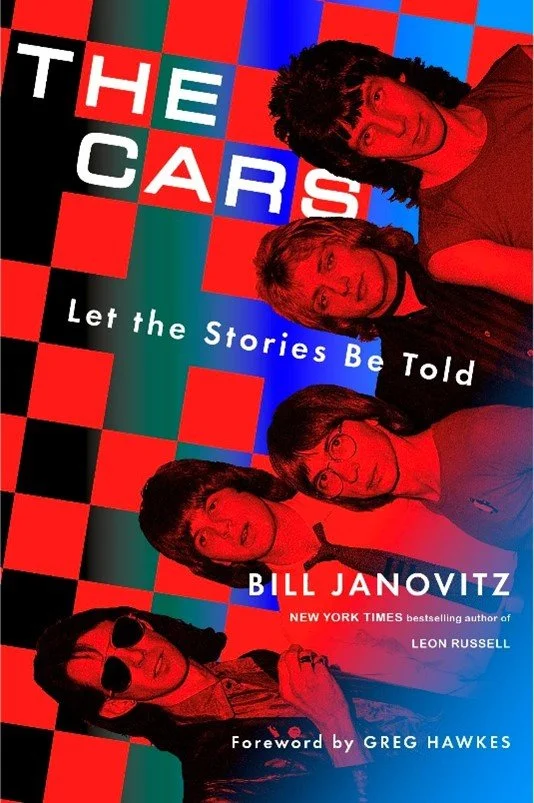
(A definitive new book about The Cars was published on September 30, 2025. Since JCE, Jeremy, Ricki C. and Colin have all now read the book, this review will capture a few thoughts from all four of them. We here at Pencil Storm figure four different opinions on the book will serve you better than one.)
JCE:
Since it was my idea to get everyone to contribute to this review, I get to go first. Let me start by sharing my personal “Cars story.” My sister attended Boston University beginning in 1977. She and her college boyfriend told me to watch out for The Cars even before their brilliant debut record was released. One thing I learned from the book is that The Cars, and a prior band that featured Ric Ocasek and Ben Orr, both played at a dive bar in a small seaside town called Scituate, just outside of Boston. My sister’s boyfriend was from Scituate and they went there often, so now I know how they knew about The Cars early on. It most definitely wasn’t from going to The Rat or listening to WBCN, because that would not have been their scene at all. Anyway, my sister later took me to see the Cars in 1980 just days after the release of the Panorama record. But that was long after their self-titled debut in 1978 and the Candy-O record had become two of my favorite records of all time. I tell you all that just to confess that I love the first two Cars records so much that the book was bound to be great in my eyes. Indeed, I did love the book, and I highly recommend it to any Cars fan. For my part of this review, I will just note a few things about the book from my perspective:
· The author of the book is Bill Janovitz, who is a founding member of his own great band, Buffalo Tom. With my being a non-musician, it is super obvious that the author is very much a musician, and that’s a good thing.
· I like my band biographies and autobiographies to tell the story in chronological order, and preferably focusing on each record the band released, one at a time. This book does exactly that.
· I like that the book includes extensive interviews with all of the living band members and other people involved. That is so much better than simply researching old news articles, etc. I will say that it would have been really interesting to have had interviews with Ric Ocasek to get his perspective, because no matter how you slice it or spin it, he comes out looking pretty bad. He was not a real nice guy based on this book.
· The book gives great insight into the making of the records and the relationships between band members and other things you would expect, but it gets into the personal lives of the band members and helps you feel like you know them a little better.
· As a result of the book, I delved into some of the later Cars records which I really haven’t ever cared that much for. The book, for me anyway, pointed out enough redeeming qualities in some of the later hits that I was forced into listening a little bit more closely. Nothing after Candy-O was remotely close to that record and the debut, but it’s not all bad either.
· I learned that WBCN’s Maxanne Sartori was a woman with some great taste in music who influenced the entire music industry. I would read a whole book about her.
I’m stopping there. For me, the book is a long overdue story about one of the coolest bands ever by a guy who can not only write, but who has the right insights and understanding of what he is writing about. It’s must-read in my opinion.
JEREMY PORTER
I’m not proud to say I don’t have the time to do much book readin’, but I can be coaxed, and I was glad JCE brought this up as a Pencil Storm collab assignment. Let the Stories Be Told was on my radar, but the push from JCE got it into my queue and I dove in.
Let the Stories Be Told is a great read – an above average rock-bio. Janovitz writes in a style that’s not so dry it reads like a textbook (Hüsker Dü: The Story of the Noise-Pop Pioneers Who Launched Modern Rock), and not so basic it reads like a 9th grader’s journal (Ace Frehley: No Regrets). He lends the perfect amount of Boston-street/scene-knowledge that outsiders wouldn’t have, subjective and objective viewpoints, and micro-detail.
Musicians will love and appreciate the studio and recording minutiae and tour stories, while non-musician fans will appreciate the more personal and historical events. It takes a while to get Ric and Ben out of Cleveland and into The Rat, but as the story winds down, you get to understand why, and how their dynamic as bandmates and friends is complicated - to say the least - and carries into their last meeting. What Janovitz perhaps does best is to bring the reader into the personalities of the band members, especially Ric and Ben, who are the most complicated, conflicted, and interesting. Ironically, he does it mostly through extensive interviews with the three surviving members.
Inline with what JCE said, Ric does not come off well in the book, and it’s somewhat of a miracle that they were able to accomplish what they did with that lineup under one man’s dictatorship. It takes a special kind of patience for a drummer to hit each drum and cymbal exactly once and not return to the studio until Mutt Lange has crafted the drum tracks without further input, using those samples created on day-one. Somehow they persevered and managed to change rock & roll despite the odds.
Benjamin Orr is the most interesting character in Cars’ lore. The dude had it all – great rock star looks, the best singing voice in the band, and a passive attitude that fueled Ric’s power grasp and helped to make their best songs hits. Elliot Easton, everyone’s favorite most-underrated guitarist, gets his due throughout, and gets shit on in the end (at the Rock and Roll Hall of Fame induction). The lack of bitterness Elliot, Greg Hawkes and David Robinson look back on the band with is admirable, if not puzzling, but one takeaway is that it seemingly was never a question: Ric wrote all the songs and called all the shots, often without even asking the band. That’s the way it was, and until late into their existence, wasn’t questioned much.
I’m an above-average Cars fan – basically worshipping the first two albums and after that, mostly the hits. I can’t get into the more-quirky stuff too deep, which is seemingly where Ric always wanted to go, and I’ve never been able to truly embrace bands and albums that rely so heavily on drum machines or programmed drums added at the end. That said, Heartbeat City (Pyromania’s twin brother for sure) has some great moments. The two albums sound almost identical, swapping out a couple Aerosmith riffs and (Def Leppard vocalist) Joe Elliot’s raspy voice for Ben’s smooth croon and Elliot Easton’s tasty riffs (when they weren’t buried). The time Janovitz spent on Heartbeat City and it’s similarity to Pyromania validated feelings I’ve been spouting for years (and perked me up, as pre-Hysteria Def Lep content will!).
Fans of The Cars and its members, the Boston music scene and history, and good rock-bios in general should check out Let the Stories Be Told. It’s a great read and highly recommended.
RICKI C.
Okay, my contribution to this blog is gonna be the shortest, because I fully admit I only read the book up to where The Cars self-titled debut record and Candy-O were discussed. (As I suspected was gonna happen as soon as I saw the book on my library’s shelf.) They pretty much lost me from Panorama on. And after my little personal mid-1980’s run-in with Ric Ocasek - Fighting With Ric Ocasek / Growing Old With Rock & Roll - they lost me even further.
I did love all The Cars’ pre-history details - Milkwood, Richard & The Rabbits, Cap’n Swing - that Janovitz put into the book. I often find those kind of pre-fame stories are my favorite part of rock & roll band autobiographies that I read. Because let’s face facts - pretty much all post-fame rock band stories are the same; drugs, groupies, divorces, car crashes, punching out fellow band members and/or rock journalists, etc. It’s not like rock musicians - other than Bob Dylan - go on to win the Nobel Prize. I really don’t anticipate even a musician I respect as much as Bruce Springsteen giving Marie Curie a run for her scientist money.
But I digress; Let The Stories Be Told was a great read (as far as I got), Bill Janovitz is a really good writer, and everybody out there with ANY interest in The Cars and their music should check it out.
COLIN GAWEL
Before I comment on The Cars, I would like to highly recommend another book by Bill Janovitz: Rocks Off - 50 Tracks That Tell The Story of The Rolling Stones. This classic is essential reading for any rock n roll book completeist. Now, onto the matter at hand.
While I wouldn’t put Let The Stories Be Told on the top shelf of my bookcase, it has less to do with Bill’s writing - which is excellent as usual - than the fact that The Cars as subject matter kind of falls flat. At no point does anyone in the band seem like they are actually having fun. Success, yes. But not much fun. Not that the book wasn’t interesting. It was, but that has become the mystery of The Cars. How can a band this successful and influential become relegated to a $300 dollar Jeopardy question in the year 2026? My hunch is that while they were a solid live act, they never really connected with an audience in a way that touched people’s souls like other bands from that era like Cheap Trick or KISS or whomever.
Additionally, they burst out of the gate with arguably the greatest debut album in rock history, so they never really spent time in the clubs winning over hardcore fans in an intimate setting.
Or put another way, lots of people love The Cars, especially the first record, but I have never met a single person with a memorable live Cars experience. Not even, “I got hammered with Ben Orr and then we went to Waffle House.”
Speaking of Ben Orr, he was Robin Zander to Rick Ocasek’s Rick Nielsen. I found it interesting that in the band previous to The Cars, Ben was strictly a lead singer. He only took up the bass when the two longtime collaborators formed The Cars. Also of note was how important drummer David Robinson was to giving the band much-needed credibility in the competitive Boston scene. The other guys had kind of been fumbling around for years but when David joined the band, with his Modern Lovers pedigree, suddenly hipsters and taste makers took notice. And it was nice to read about the important musical contributions Greg Hawkes and Elliot Easton made to the band’s unique sound. All five guys had a vital role.
Of course, songwriter and sometimes Ricki C. antagonist Ric Ocasek is the straw that stirred this drink. Ric was a complex and talented individual. He was smart enough to ride Ben’s star power on some of their biggest hits like “Just What I Needed,” “Let’s Go,” and “Drive,” but seemed resentful when Ben was getting too much of the spotlight. Ric’s penchant for suddenly abandoning two different wives, with both of whom he had kids, is a troubling sign as well. But, more often than not he was a gentle soul trying to do his best despite character flaws. He and Ben spent over a decade trying to “make it” so that kind of dogged determination was bound to leave a trail of destruction and hurt feelings. But…he ultimately made his band members both rich & famous, and that isn’t to be taken lightly.
Also, Mutt Lange sounds like a real jack-ass, which I sort of suspected.
MILKWOOD (Ben Orr, Jim Goodkind, Ric Ocasek) / circa 1972, CLEVELAND
RICHARD & THE RABBITS (Ric Ocasek & Ben Orr) / circa 1974, BOSTON
CAP’N SWING (The Cars pictured; only Ocasek, Orr & Elliott Easton in this band) / circa 1976, BOSTON
THE CARS (Ocasek, Orr, Easton, Greg Hawkes and David Robinson) / circa 1978, BOSTON
THE CARS / live 1978 (thank god for Roy Thomas Baker and multi-tracked, layered vocals)
THE CARS / complete live set, 1979